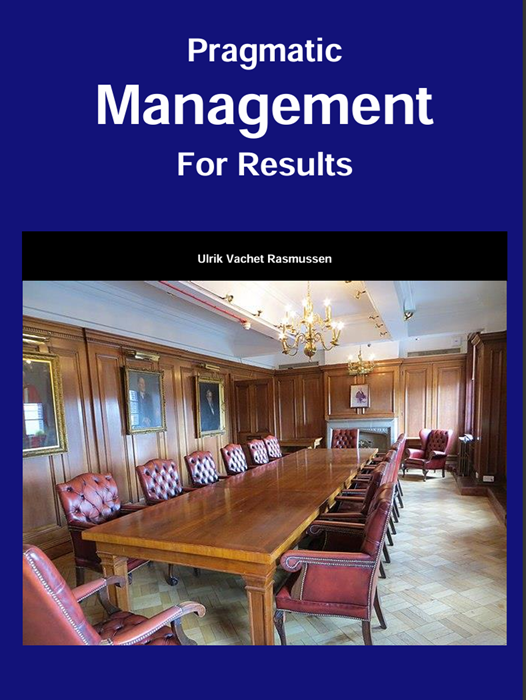
A Practical Framework for Evidence-Based Management
Pragmatic Management For Results was written from the conviction that successful organisations are built upon evidence rather than fashion, rational analysis rather than intuition, and coherent management rather than isolated techniques. Finance, strategy, leadership, marketing and operations are treated as interconnected disciplines whose interaction ultimately determines organisational performance.
Drawing upon more than two decades of executive experience, the book combines practical management with systematic analysis to develop a framework that can be applied across industries. The emphasis throughout is evidence-based management: decisions should be grounded in observable results, measurable performance and disciplined reasoning.
Why this book was written
Much of the management literature examines individual disciplines in isolation. Leadership, finance, marketing, operations and strategy are frequently treated as separate fields with their own theories and methods. In practice, however, organisations function as integrated systems in which every important decision has consequences across multiple domains. The purpose of this book is therefore to present management as a unified discipline founded upon evidence, analysis and practical experience.
Rather than promoting fashionable management concepts, Pragmatic Management For Results seeks enduring principles. It argues that executives should begin with facts, identify the relationships between organisational functions, evaluate alternatives rationally and judge success by measurable outcomes. The result is a practical framework intended for managers, entrepreneurs and students who seek systematic rather than ideological approaches to management.
Principal Themes
Evidence-Based Management
Sound management begins with evidence. Decisions should be based upon measurable facts, disciplined observation and objective evaluation rather than management fashions or unsupported assumptions.
Integrated Thinking
Finance, leadership, operations, marketing and strategy are not independent disciplines. Each influences the others, and successful management depends upon understanding these relationships.
Execution
Ideas acquire value only when they are implemented effectively. Strategy and execution are complementary rather than competing managerial activities.
Long-Term Results
Organisations should be managed with the objective of sustainable improvement, organisational learning and enduring competitive performance.
The Book
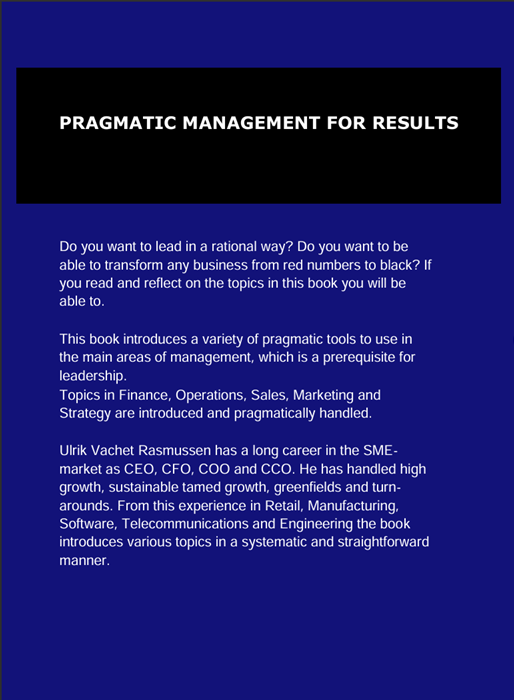

About the Author
Ulrik Vachet Rasmussen has served as CEO, CFO, COO and CCO across software, telecommunications, manufacturing, engineering and retail. His professional experience includes growth companies, turnarounds and strategic transformation projects. Pragmatic Management For Results established a methodological approach that continues throughout his later historical and philosophical works: evidence-based reasoning, systems thinking and the search for underlying principles capable of explaining complex organisations.