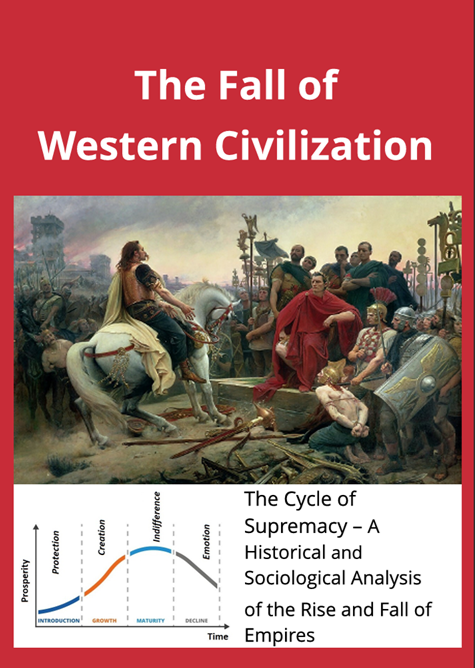
The Fall of Western Civilization

Towards a General Theory of Civilizational Development
An interdisciplinary study of eight major empires and the structural forces shaping the rise and fall of civilizations.
Front Cover

Towards a General Theory of Civilizational Development

The Fall of Western Civilization develops a comprehensive interdisciplinary theory explaining why civilizations rise, flourish, mature and ultimately decline. Drawing upon history, sociology, economics, political science and demography, the book seeks to identify the structural mechanisms governing long-term civilizational development rather than merely recounting historical events.

History is more than a sequence of events. It reveals recurring patterns through which civilizations rise, mature, decline and ultimately disappear.

Rather than presenting isolated historical narratives, the work compares eight major empires across more than two millennia. Historical evidence is integrated with institutional analysis, demographic research and economic development to construct a coherent four-phase model that is finally applied to the contemporary Western world.
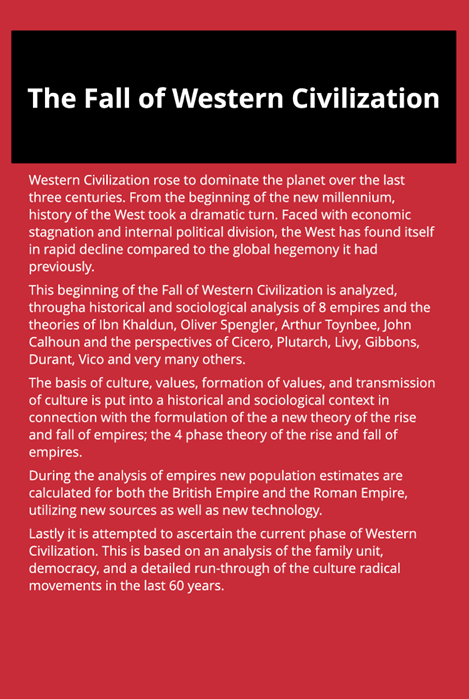

Why this book was written

Most historical works describe individual civilizations exceptionally well. Far fewer attempt to explain the common mechanisms governing their development. This work argues that civilizations can only be understood by integrating historical evidence with sociology, economics, demography and institutional analysis. Political events alone cannot explain why civilizations prosper or decline; they are manifestations of deeper structural forces operating over centuries.

Through a comparative study of eight major empires, the book develops an evidence-based analytical framework capable of explaining historical development across more than two thousand years before applying the same framework to the contemporary Western world.

Principal Themes

Comparative Civilizations

Eight major empires are examined comparatively across more than two thousand years in order to distinguish recurring historical mechanisms from unique historical events.

A Four-Phase Theory

A general model describing the rise, maturity, decline and fall of civilizations by integrating historical observation with sociological, demographic and economic analysis.

Economics & Demography

Population dynamics, institutions, prosperity and economic development are analysed as measurable forces shaping the long-term trajectory of civilizations.

The Modern West

The historical framework is ultimately applied to contemporary Western civilization in order to assess its present historical position within the broader cycle of civilizational development.

The Book

Front Cover

The Fall of Western Civilization combines history, sociology, economics, political science and cultural analysis into a unified explanation of civilizational development. Eight major empires are investigated comparatively, integrating demographic evidence, institutional history and economic analysis into a coherent explanatory framework.

The work engages with ideas developed by Ibn Khaldun, Polybius, Cicero, Livy, Plutarch, Gibbon, Spengler, Toynbee, Calhoun and many others while proposing an original synthesis.

Rather than presenting isolated narratives, the book develops an integrated model explaining how values influence institutions, institutions shape prosperity and prosperity ultimately determines the long-term strength or decline of civilizations. The concluding chapters apply this framework to the modern Western world.

Back Cover

Structure of the Book

The work progresses from historical foundations to comparative analysis before developing a general theory of civilizational development and finally applying that framework to the contemporary Western world.

Part I — Foundations
• Civilization, culture and values
• Institutions and methodology
• Sociology and economics

Part II — Comparative Empires
• Eight historical empires
• Comparative historical analysis
• Institutions, demography and prosperity

Part III — Towards a General Theory
• Rise, maturity, decline and fall
• Demography and economics
• Structural mechanisms of historical change

Part IV — The Contemporary West
• Applying the model
• Demographic, economic and cultural trends
• Long-term historical outlook

Available on Amazon.com →

Available worldwide in paperback and Kindle editions.

About the Author

Ulrik Vachet Rasmussen is an independent author and researcher whose work combines historical demography, sociology, economics and political theory with evidence-based analysis. His publications seek to identify enduring principles governing organizations, civilizations and human societies through interdisciplinary research.